How Fast Should You Type? A Guide to WPM and Typing Speed Tests
Why Typing Speed Still Matters
Even with voice-to-text and autocomplete everywhere, typing speed still shapes how quickly you get through emails, code, chat messages, and documents. A faster, more accurate typist doesn't just save time — they spend less mental energy on the mechanics of typing and more on what they're actually trying to say.
The tricky part is that most people have never actually measured their typing speed. They just assume they're "pretty fast" or "not great," without a real number to compare against.
What Does WPM Actually Mean?
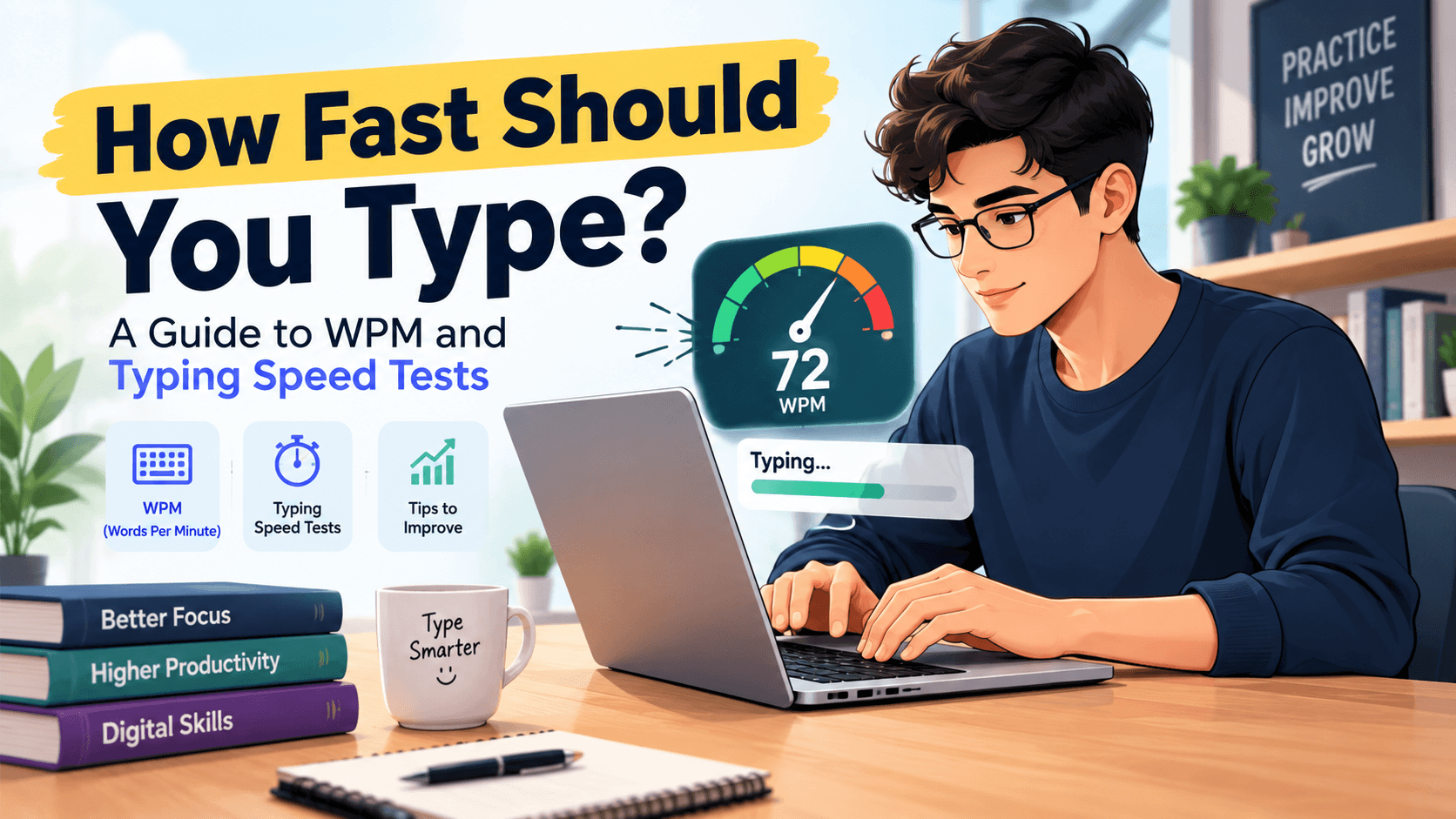
WPM stands for Words Per Minute — the number of words you can type accurately in one minute. It's calculated by counting the total words typed and dividing by the time taken in minutes. Most typing tests use this as the standard measure of speed, alongside accuracy, since typing fast with constant mistakes isn't actually useful.
What's a Good Typing Speed?
Typing speed benchmarks generally break down like this:
- Under 30 WPM — below average; typing may feel effortful and slow
- 30–50 WPM — average for most casual computer users
- 50–70 WPM — strong, comfortable speed for most jobs
- 70+ WPM — excellent, often seen in professional typists, transcriptionists, and heavy computer users
Accuracy matters just as much as raw speed. A fast typist making frequent mistakes often ends up slower overall once you factor in the time spent correcting errors.
Standard Test vs. Timed Sprint
Typing tests usually come in two formats:
- Fixed passage test — you type a specific piece of text from start to finish, and your WPM is calculated once you complete it
- Timed sprint — you type for a fixed duration (commonly 60 seconds), and your WPM reflects how much you typed in that window
The fixed passage format is useful for measuring accuracy on a consistent piece of text, while a timed sprint feels closer to real typing under pressure, since you're racing the clock rather than the text length.
How to Actually Improve Your Typing Speed
Typing speed improves with deliberate, regular practice — not by typing more in general, but by practicing with intent:
- Avoid looking at the keyboard, even if it slows you down at first
- Practice a little daily rather than occasionally for long sessions
- Track your WPM over time to see real progress, not just a guess
- Focus on accuracy first — speed naturally follows once mistakes drop
Test Your Speed
The only way to know your actual typing speed is to measure it. A quick WPM test takes less than a minute and gives you a real number to track — and to try to beat next time.